English
 Dutch
Dutch Japanese
 Hindi
Hindi Italian
 Spanish
 French
 German
 Chinese
 Korean
 Arabic
 Hebrew
 Russian
 Portuguese
 Danish
 Czech
Czech Polish
 Swedish


Need Help? Let's Talk
+977 9841965533

Trip Facts
|
Trip Duration
14 Days |
|
|
Region
Manaslu Treks |
|
|
Country
Nepal |
|
|
Group Size
2 To 15 Trekkers |
|
|
Arrival On
Kathmandu |
|
|
Departure From
Kathmandu |
|
|
Best Season
Pre & Post Monsoon |
|
|
Max Altitude
5125 M |
|
 Moderate level treks usually above 7 days. Altitude can reach 5000 meters with 5-6 hrs of hike per day. Moderate refers to neither easy walk nor tough. High altitude may matter on walking speed and distance. Acclimatization may be required.
| Trip Grade Moderate |
|
Activities
Nepal Trekking
|
Manaslu Circuit Trek Overview
The Manaslu Circuit Trek is one of Nepal’s most beautiful and adventurous trekking routes. This is a trip around Mount Manaslu, which is the 8th highest mountain in the world with a height of 8,163 m / 26,781 ft. The trek is an ideal combination of nature, culture, and mountain adventure of high level.
The Manaslu Circuit Trek is relatively newer and less frequented than some of the other busier trekking paths in Nepal, and thus, it is an excellent option to choose when a traveler desires to experience the Himalayas serenely.
The trek typically starts with a picturesque drive from Kathmandu to Machha Khola, situated at approximately 870 m / 2,854 ft. From here, the road takes the Budhi Gandaki River via deep valleys, ancient villages, and forests. The farther you go into the mountains, the more the scenery transitions to alpine with the topographical views of the mountain ranges that are covered with snow.
The cultural differences encountered during the Manaslu Circuit Trek are due to the cultural diversity of the route. In the village below, trekkers encounter Gurung communities with firm Hindu cultures. In the mountains, particularly in such villages as Sama Gaun (3,520 m / 11,549 ft), Tibetan Buddhism culture is more pronounced with monasteries, prayer wheels, and colorful prayer flags. Such cultural experiences provide trekkers with an insight into the life of the mountains in Nepal.
The best part of the Manaslu Circuit Trek is the famous Larkya La Pass (5,135 m / 16,847 ft). The high mountain pas sis able to provide spectacular views of the Himalayan mountains like Himlung Himal, Annapurna II, and Kang Guru that surround the area. The pass is a very difficult and memorable experience for trekkers to reach.
Manaslu Circuit Trek normally takes 14 days to complete the whole circuit. Trekking involves walking through hilly areas, lodging in the local tea houses during the period, and enjoying the welcoming nature of mountain societies. The pathway comprises acclimatization days to assist the body in adapting to the higher altitudes.
The Manaslu Circuit Trek is an adventure that is rewarding and offers the perfect blend of breathtaking landscapes of the Himalayas, cultural diversity and adventure. This is a lifetime experience that trekkers would not forget, in case they want to experience a true Nepalese trekking experience.
Mission Himalaya Treks organizes this trek and manages all logistics, including permits, guides, transportation and accommodation. The experienced team ensures a safe, smooth and enjoyable trekking experience throughout the journey.
Why Choose the Manaslu Circuit Trek Over Other Routes?
Manaslu Circuit Trek is a popular route among trekkers who prefer to have a more authentic and peaceful Himalayan experience. The Manaslu region is not as crowded as popular routes such as the Everest or the Annapurna and it provides a serene trekking experience. The path cuts across a variety of scenery, from the river valley to the high Himalayas.
Such villages as Sama Gaun (3,520 m / 11,549 ft) offer a distinct Nepali-Tibetan blend. The best moment in the trek is the Larkya La Pass (5,135 m / 16,847 ft), which is the viewpoint of the surrounding mountains like the Himal Chuli and Annapurna II.
Manaslu Circuit Trek is not only a beautiful mountain trek, but it is also a cultural and adventure trip, which is ranked among the most fulfilling trekking trails in Nepal.

5.0
317 reviews
Trip Highlights:
- See the close-up of 8th highest mountain in the world, Mount Manaslu (8,163 m / 26,781 ft).
- Walk across the scenic Larkya La Pass at (5,135 m / 16,847 ft).
- Hike on quieter trails than some of the more common trekking trails in Nepal.
- Explore the local culture of such villages as Sama Gaun (3,520 m / 11,549 ft).
- Stroll across a variety of terrains such as forests, rivers, and alpine valleys.
- See beautiful Buddhist Monasteries like the Ribung Monastery in Lho.
- Visit local tea houses and experience the hospitality of the mountains.
- Witness spectacular mountains such as HimlungHimal, Annapurna II, and Ganesh Himal.
- Discover the isolated Himalayan villages whose traditions and lifestyles have been maintained for centuries.
- The Manaslu Circuit Trek is the ultimate adventure, nature, and cultural experience.
Larkya Pass in Winter
Due to heavy snow, the Larkya La Pass may close. If the pass is closed, our guides and porters will be unable to cross in winter. Please do not attempt to cross in high-risk conditions.
Manaslu Circuit Trek Itinerary
Day 1: Arrival in Kathmandu
Walking Hours: 30 Minutes Drive
Meals Included: Welcome Dinner
Accommodation: 3 Star Standard Hotel
Max. Altitude: 1345 m
Distance: 5 kilometer
Difficulty Level: Easy
Welcome to Nepal! You will be received by one of the representatives of Mission Himalaya once you reach Tribhuvan International Airport, which is situated at approximately 1,345 m (4,413 ft). Once you meet the team, you will be taken to your hotel in Kathmandu. The ride to the hotel is an opportunity to get the first glimpse of the Nepalese capital city and see the colorful streets, temples, and local markets there.
After the journey, you can relax once you reach the hotel. In the evening, you will join your guide and team members on a welcome dinner. In this gathering, your trek guide will provide a concise overview of the Manaslu Circuit Trek. The briefing will contain information regarding the trekking path, day-to-day plans, safety rules, authorizations, and extra equipment that are necessary for the tour.
You can also ensure that you check your trekking equipment and buy or rent out whatever you are lacking in the nearby shops in Thamel. The crew will respond to any of your inquiries pertaining to the adventure you will have.
Once the briefing and dinner are over, you can relax well at the hotel and look forward to the days of excitement that the trek will soon start.
Day 2: Kathmandu Sightseeing & Permit Processing
Meals Included: Breakfast, Lunch and Dinner
Accommodation: 3 Star Standard Hotel
Max. Altitude: 1345 m
Distance: 3 to 5 km walk
Difficulty Level: Easy
Today, you get to learn more about the rich culture of Kathmandu as the trekking group gets the permits that are needed to navigate through the Manaslu Circuit Trek. Kathmandu is renowned for its temples, stupas, and historic monuments. You start a guided tour of the city after having breakfast at the hotel.
The initial destination is Boudha Stupa, which is among the biggest Stupas of Buddhism in the world. It is a spiritual place due to the tranquillity and spinning prayer wheels. Then, you come to Pashupatinath Temple, which is a holy Hindu temple situated along the river Bagmati. Daily prayers and rituals are done by pilgrims.
Then you proceed to Kathmandu Durbar Square, which has ancient palaces, temples and courtyards that depict the royal history of Nepal. You can also visit the house of the goddess Kumari. With time, you can visit Swoyambhu Stupa or Monkey Temple, which lies on a hill with a panoramic view of the valley with a beautiful landscape.
You come back to your hotel in the evening. You are advised to go to sleep early and get ready for the long drive to the Manaslu region tomorrow.
Day 3: Drive from Kathmandu to Machha Khola
Walking Hours: 7 To 9 Hours Driving
Meals Included: Breakfast, Lunch, And Dinner
Accommodation: Lodge
Max. Altitude: 1,350 m
Distance: 161 kilometer
Difficulty Level: Bumpy drive
After breakfast, you start your journey in the Manaslu region. You start in Kathmandu (1,350 m /4,429 ft) and go along the beautiful Prithvi Highway. The route has a beautiful river, green hills, and rural villages on its way. The road goes along the Trishuli River, then takes a turn to the Budhi Gandaki Valley.
On your way northwest, you find the scenery gradually fading into small bustling towns and into quiet country. You move through like Benignat and Arughat, where you can find the traditional Nepali village lifestyle. The farmers are busy working in the terraced fields, and small tea shops are on the side of the roadways.
The last part of the road is rough and unpaved, and makes the drive more adventurous. After a few hours, you arrive in a place called Machha Khola, which is a place with an altitude of approximately 870 m (2,854 ft). The Budhi Gandaki River is the entry point to your trek, with this small village being the starting point of the trek.
You will be staying in a tea house where you can have time to relax and have your first meal in the mountain region. In the evening, pack your trekking equipment and set up for your first day of trekking the next day.
Day 4: Trek fromMachha Khola to Jagat
Walking Hours: 7 To 8 Hours Trekking
Meals Included: Breakfast, Lunch, And Dinner
Accommodation: Lodge
Max. Altitude: 1340 m
Distance: 22.2 kilometer
Difficulty Level: Moderate
The initial day of your trek starts at Machha Khola (870 m / 2,854 ft). You move on after breakfast along the trail of the Budhi Gandaki River, passing through bamboo and pine woods. You follow the sound of the running river on your way into the Manaslu region even further.
The path has a number of suspension bridges over the river and village tracks. In between, you come to Tatopani, a location with natural hot springs where most trekkers have a brief rest. On the way, you will see small villages and agricultural land, where people cultivate and farm their land. Slowly, the track ascends into the hills and glacial valley of the river.
After a few hours, you come to a beautiful village named Jagat (1345 m / 4413 ft). The local culture is reflected in the stone houses, Buddhist prayer flags, and traditional mani walls. The first full day of trekking ends in the peaceful village, where one can rest.
Day 5: Trek from Jagat to Deng
Walking Hours: 5 To 6 Hours Trekking
Meals Included: Breakfast, Lunch, And Dinner
Accommodation: Lodge
Max. Altitude: 1860 m
Distance: 19.9 kilometer/12.3 miles
Difficulty Level: Moderate
The trail after breakfast takes you along a picturesque path along the Budhi Gandaki River. It goes through agricultural land, forests, and small villages where natives still lead a traditional life.
You go over a number of suspension bridges and through terraced fields where there are seasonal crops. The road is slowly ascending and descending with the river valley, and provides the beauty of the hills nearby. Halfway through the journey, you get to the quiet village of Sirdibas, where trekkers take lunch.
At this point, we ascend the mountain along a ridge with spectacular views of the valley down the mountain. The path then turns off down a little towards Philim(1,530 m / 5,020 ft). The village of Philim is a vibrant place with vast lands and a cultural background.
Going further across bridges and forest trails, you come to Deng (1,860 m / 6,102 ft). Deng is a village that has Tibetan influences like prayer flags and mani walls. Today you spend the night in a lodge and have the restful mountain surroundings.
Day 6: Trek from Deng to Namrung
Walking Hours: 5 To 6 Hours Trekking
Meals Included: Breakfast, Lunch, And Dinner
Accommodation: Lodge
Max. Altitude: 2630 m
Distance: 19.4 kilometers
Difficulty Level: Moderate
The journey is now carried on farther into Manaslu. Your day starts with breakfast in Deng (1,860 m / 6,102 ft), and then you start a beautiful walk through a picturesque path that gradually ascends through thick bamboo, rhododendron, and pine woods. At higher altitudes, the scenery begins to seem more alpine, and the air becomes colder.
The road goes through a number of smaller villages where one can see the local mountain life. The terraced fields are being worked by the farmers, and the presence of prayer flags and stone mani walls witnesses the culture of Tibetan Buddhism that is dominant in the area. On the road, you pass the Budhi Gandaki River once again and proceed on through quiet woods and little paths.
With the increase in height, there are mountain scenes emerging. The distant mountains include Snow-white mountains like Singri Himal and Ganesh Himal. The path slowly climbs up until Namrung (2,630 m / 8,629 ft).
The village of Namrung is beautiful, with barley fields, small monasteries, and stone houses. It is a nice location to rest and start adapting to the elevated altitude. Once you reach the lodge, you are able to have a tour around the village and experience the peaceful mountainous atmosphere.
Day 7: Trek from Namrung to Sama Gaun
Walking Hours: 7 To 8 Hours Trekking
Meals Included: Breakfast, Lunch, And Dinner
Accommodation: Lodge
Max. Altitude: 3520 m
Distance: 17.7 kilometers
Difficulty Level: Moderate
The day starts with a sunrise above the Himalayan mountains around it. We leave Namrung and progressively ascend to the altitude of the higher alpine areas. The path cuts across little villages and bare hillsides on which are fluttering the prayer flags in the mountain wind.
The first village we pass is Lihi(3,100 m / 10,171 ft). In this village, there are old houses, made of stone, and a few small monasteries. One can see the spectacular views of the north face of the mountain Manaslu across the valley.
The journey goes on to Lho Village with the Ribung Monastery, which has one of the finest vistas of the mountain Manaslu (8,163 m / 26,781 ft). The trail after a lunch rest at Lho rises through rocky country, across broad valleys, where the surrounding mountains such as Himal Chuli and Ngadi Chuli can be seen.
The trail then finally slopes into Sama Gaun (3,520 m / 11,549 ft). It is a big Sherpa village located in a broad valley, and it is a major acclimatization point. The village monastery and the scenery are some of the memorable places to stay.
Day 8: Sama Gaun Acclimatization Day
Walking Hours: 4 hrs
Meals Included: Breakfast, Lunch, And Dinner
Accommodation: Lodge
Max. Altitude: 3520 m
Distance: 10.2 km For MBC Round Trip
Difficulty Level: Easy
The day is a significant rest and acclimatization day in Sama Gaun (3,520 m / 11,549 ft). A day’s rest here can allow your body to get used to the rising altitude to move on to higher levels on the trek.
Short hikes are advised even though it is a rest day. Among the most frequented itineraries is a hike to Manaslu Base Camp with its amazing scenery that comprises glaciers and mountains. The hiking time is typically 5-6 hours round trip, and higher altitudes are covered, then back to the village.
Another option is the less-traveled route, which brings one to Punggen Monastery, which is a serene place offering excellent sightseeing opportunities of the Manaslu mountain. Another tourist spot that can be visited by trekkers is the Birendra Lake, which is a glacial lake situated close to the village.
You can visit the stone houses of Sama Gaun, study local Sherpa culture, and see yaks grazing in the local fields. Spending the day in a slow movement and a lot of water serves the purpose of preparing your body for the increased altitude in the future.
Day 9: Trek from Samagaun to Samdo
Walking Hours: 5 To 6 Hours Trekking
Meals Included: Breakfast, Lunch, And Dinner
Accommodation: Lodge
Max. Altitude: 3860 m
Distance: 16.4 kilometers
Difficulty Level: Difficult
Leaving Sama Gaun (3,520 m 11,549 ft), the trail goes high alpine route to the remote village of Samdo. It narrows down and over a bridge spanning a roaring mountain torrent, forcing its way off Ngidi Chuli Glacier.
The path is thereafter along exposed forests that have juniper and birch. On the road, you can find resting yaks on the hillsides as well as have expansive scenery of the mountains around.
It takes several hours of trekking so that you arrive at Kermo Kharka, which is a traditional grazing ground by the local herders. Here, the path leads gradually up to Samdo.
At last, you come to Samdo(3,860 m / 12,664 ft). This is the final inhabited village before the Larkya La Pass. Samdo is heavily influenced by the Tibetan culture, and most of the residents have a historical trade relationship with Tibet.
The village is very quiet with beautiful mountain scenery and a serene environment. Once there, you will be able to rest, inspect your equipment, and get ready to go higher.
Day 10: Trek fromSamdo toLarkyaPhedi (Dharmashala)
Walking Hours: 4 To 5 Hours Trekking
Meals Included: Breakfast, Lunch, And Dinner
Accommodation: Lodge
Max. Altitude: 4460 m/14631 ft
Distance: 11.7 kilometers
Difficulty Level: Moderate
Today’s trek takes you closer to the highest point of the Manaslu Circuit. Leaving Samdo (3,860 m / 12,664 ft), the path first goes through a very small bridge. Then the route starts a gradual ascending climb over a rocky alpine landscape.
The scenery is even more rugged as you pass by the glacial valleys and mountain ridges. On the path, you can see the remains of Larkya Bazaar, an ancient trading ground which had linked Nepal and Tibet.
It proceeds along the trail through moraine fields and ascends slowly to Larkya Phedior Dharmashala (4,460 m / 14,633 ft). This is a little village, the last stopping place before traversing the high mountain pass.
The climbing rate is kept low and constant as the altitude is quite high. Once at the lodge, the remaining afternoon is spent taking a rest, drinking warm fluids, and getting equipped to start early the next morning.
Day 11: Cross Larkya La Pass to Bhimtang
Walking Hours: 7 To 8 Hours Trekking
Meals Included: Breakfast, Lunch, And Dinner
Accommodation: Lodge
Max. Altitude: 3750 m
Distance: 24.6 kilometers
Difficulty Level: Very Difficult
This is the most difficult and interesting day of the trek. The trip starts very early in the morning at Larkya Phedi (4,460 m / 14,633 ft). Trekkers wear warm clothing and trekking gear, using headlamps as they begin the long climb toward the high mountain pass early in the morning.
The path slowly climbs over glaciers and mountainous slopes. In the morning, when the sun rises, incredible pictures of the Himalayan mountains around are observed. After several hours of ascending, you get to the Larkya La Pass summit (5,135 m / 16,847 ft), which is the highest point of the Manaslu Circuit Trek.
The pass is decorated with colorful prayer flags, and the panoramic views of Annapurna II, Himlung Himal, and Kang Guru give a memorable experience.
The trail then starts a long downward slope with snowy slopes and glacial moraine after a celebration at the top of the mountain. This goes to Bhimtang(3,750 m / 12,303 ft), a green-meaded valley with its mountain-views, which is a pleasant place to rest after the tiring crossing.
Day 12: Trek from Bhimtang to Dharapani
Walking Hours: 5 To 6 Hours Trekking
Meals Included: Breakfast, Lunch, And Dinner
Accommodation: Lodge
Max. Altitude: 1963 m
Distance: 15.8 kilometers
Difficulty Level: Difficult
The day’s walk is mainly downhill after the difficult pass crossing. From Bhimtang (3,750 m / 12,303 ft), the trail enters beautiful forests with rhododendron, pine trees, and oak trees.
This trail is on the riverbed of the Dudh Khola, and provides a quiet walking experience with waterfalls and mountain streams on the trail. The lower the altitude, the warmer the air is and the greener the vegetation.
On your way, you also go through a few small villages, such as Tilije, which has its traditional Gurung culture. Most of the trekkers have lunch here and like the atmosphere of the place.
The path goes through more suspension bridges and forest tracks, and you arrive in Dharapani(1,963 m/6,440 ft). One of the key crossroads in this region is Dharapani, where the Manaslu Circuit path intersects the Annapurna Circuit Trek path.
Upon reaching there, you are able to rejoice with your guide and crew in that you have completed the trekking segment.
Day 13: Drive from Dharapani to Besisahar and to Kathmandu
Walking Hours: 8 To 9 Hours Driving
Meals Included: Breakfast, Lunch, and Dinner
Accommodation: 3 Star Standard Hotel
Max. Altitude: 1345 m
Distance: 119 kilometers
Difficulty Level: Easy
You start the trip back to Kathmandu after having breakfast in Dharapani (1,963 m / 6,440 ft). You drive through the mountain road with scenic views of the Marshyangdi River.
The road crosses a number of villages such as Tal, Chamje, and Syange, where there are waterfalls and terraced fields adorning the hills. On the way, you find that after a few hours, you are at Besisahar, the main town of Lamjung District.
At Besisahar, you change to a tourist bus to take you back to Kathmandu. The road is based on the highway, and that is a beautiful countryside with a riverside view.
In the evening, you are back in Kathmandu (1,345 m / 4,413 ft). A farewell dinner will be arranged in Thamel in the evening by the end of the Manaslu Circuit Trek, where you will celebrate the successful completion of your trek with your guide and trekking team.
Day 14: Departure or Extend Stay
Walking Hours: 30 Minutes Drive
Meals Included: Breakfast
Accommodation: None
Max. Altitude: 1355 m
Distance: 5.1 kilometer to TIA Airport
Difficulty Level: Easy
Today is the end of your Manaslu adventure in Kathmandu (1,355 m / 4,446 ft). You can have a leisurely morning after breakfast at the hotel, depending on your flight schedule.
In case you are leaving Nepal today, the Mission Himalaya group will provide a transfer to Tribhuvan International Airport to board a plane. It will take approximately 30 minutes to reach the airport, depending on the traffic.
You can also spend more time in Kathmandu if you have some spare time. Several fascinating locations include traditional markets, temples, and local restaurants found in the city. Some tourists also like taking a spa or massage after the arduous journey.
This last day is a good time to think of the memorable trip around Mount Manaslu, the amazing scenery which you got to see, and the friendships which you have made in the process of the trek.
Manaslu Circuit Trek Cost
The cost varies depending on the Kathmandu hotel, the number of trekking days, inclusion items, the type of accommodation, the guide’s experience, and the number of porters.
-
Hotel accommodation in Kathmandu with breakfast before and after the trek.
-
Transportation from Kathmandu to MachhaKholaand from Dharapani to Kathmandu
-
All necessary permits of the Manaslu region, including restricted area and conservation permits.
-
Skilled English guide and porters in trekking (1 porter 2 trekkers).
-
Accommodation in teahouses in twin sharing during the trek
-
Three meals a day on the trek: breakfast, lunch and dinner.
-
Kathmandu heritage tour.
-
Trekking gear assistance upon request (sleeping bag, down jacket, and duffel bag).
-
A first-aid kit and a pulse oximeter with the guide.
-
Trek completion certificate from Mission Himalaya Treks.
-
International flights in and out of Nepal and the Nepal entry visa fee.
-
Personal travel insurance.
-
In Kathmandu, lunch and dinner, and all the beverages on the trek.
-
Personal costs include hot showers, charging devices, Wi-Fi, laundry, snacks, and shopping.
-
Tips for guides and porters.
-
Additional accommodation or services because of the change of the itinerary, coming early, or coming late.
-
Anything else not mentioned in the inclusion list.
Trip Gear


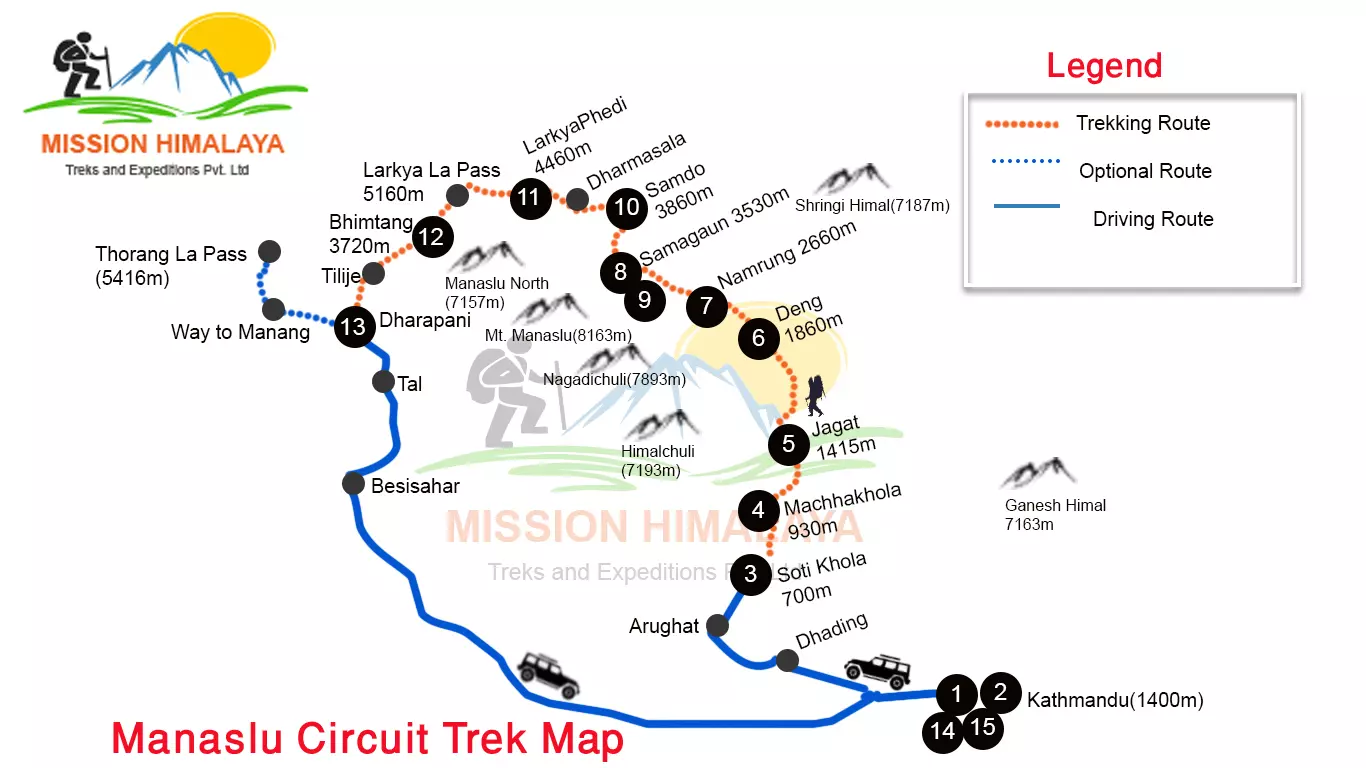
Manaslu Circuit Trek Map
 Download Map
Note That Map not in scale. Map day and altitude can e different according to Number of Days and Stayed accommodations.
Manaslu Circuit Trek Related Information
Difficulty & Daily Physical Demands
Manaslu Circuit Trek is regarded as a moderate to challenging trek in the Himalayas. Trekkers tend to cover 5-8 hours daily on mountain trails involving steep ascents, rocky trails, and suspension bridges. There are some days during which the elevation may increase up to 800-1,000 meters, and this aspect demands constant activity and excellent stamina.
On the 7th day of the Manaslu Circuit Trek, the trekkers are at Sama Gaun at (3,520 m / 11,549 ft), where the atmosphere becomes considerably thinner. The hardest day is the Larkya La Pass (5,135 m / 16,847 ft).
Positive cardiovascular status, tolerance, and slow speed make the trekkers manage the physical challenges of the day. Most of the fit trekkers will successfully finish this rewarding adventure with proper preparation and support of the guides and porters.
Best Season and Weather
The Manaslu Circuit Trek requires the right season to be successful. The spring (March to May) and autumn (September to November) are the most appropriate times to visit.
During spring, the paths are bright, the forests of rhododendron bloom, and the mountains are visible. Autumn has good weather, dry tracks, and the best view of the Himalayas. Daytime temperatures in the lower valleys can be 15-20 °C, but in higher villages such as Sama Gaun (3,520 m / 11,549 ft), the temperature is lower. Towards the top of the Manaslu Circuit Trek, Larkya La Pass (5,135 m / 16,847 ft), the temperature may fall below zero.
The time of winter is full of heavy snowfall, and the time of summer is full of landslides and monsoon. Spring and autumn seasons are the most preferable due to safety, comfort, and beautiful scenery.
Altitude, Acclimatization Strategy, and AMS Prevention
Elevation is one of the largest issues in the Manaslu Circuit Trek. The trek starts below 1,000 meters and rises gradually to Larkya La Pass (5,135 m / 16,847 ft). Trekkers gain height, and the air gets thinner, and this may cause Acute Mountain Sickness (AMS).
In order to minimize this risk, acclimatization is highly essential. One of the main acclimatization rests is at Sama Gaun (3, 520 m / 11 549 ft), where the trekkers have an additional day off or can do small hikes. Drinking 3-4 liters of water each day and consuming sufficient amounts of food will make the body adapt to the altitude.
The typical symptoms of the AMS are headache, dizziness, and nausea. Guides keep an eye on the health of trekkers and advise on slow and gradual walking. Most of the people safely complete the Manaslu Circuit Trek with gradual ascents and good care.
Training, Fitness Level & Mental Preparation
It is better to be prepared physically and psychologically to make the Manaslu Circuit Trek more comfortable for the trekkers.
The training must begin 2 or 3 months before the trip. Hiking, running, cycling, and stair climbing are activities that enhance cardiovascular fitness and endurance. It is good to practice with a small pack to create an imitation of actual trekking. You can also build leg strength by doing exercises such as squats and lunges.
In the Manaslu Circuit Trek, the trekkers go up the mountain gradually to high villages such as Sama Gaun (3,520 m / 11,549 ft) and the Larkya La Pass (5,135 m 16,847 ft).
The psychological training is also necessary since the trek takes approximately 2 weeks to reach remote mountainous regions. Patience, positivity, and flexibility are all that can help trekkers to cope with walking long periods and varying weather conditions, and admire the Himalayas’ beauty.
Meals on the Trail: Food Quality, Menu Variety & Dietary Options at High Altitude
The foods on the Manaslu Circuit Trek are served in traditional tea houses on the trail. Dal bhat, or healthy rice, lentil soup, and vegetable food is the most widespread dish, and it gives lots of strength for trekking. The breakfast usually consists of pancakes, eggs, toast, or porridge. Lunch and dinner menus can include fried rice, noodles, pasta, soups, and vegetable meals.
Fresh food supply is reduced as trekkers move to elevated villages like Sama Gaun (3,520 m / 11,549 ft), as the food that gets up the mountain has to be carried along. Nevertheless, the meals are healthy and satisfactory. There isa wide range of vegetarian and vegan dishes, particularly dal bhat.
In the Manaslu Circuit Trek, tourists must consume boiled or filtered water and bring some snacks like energy bars or nuts as additional sources of energy.
Accommodation
The Manaslu Circuit Trek is primarily accommodated in local mountain lodges called the tea houses. These lodges provide the guests with simple twin-sharing rooms with two single beds, blankets, and pillows. The higher the elevation is, the more basic a facility will be, such as Samdo (3,860 m / 12,664 ft) and Dharmashala (4,460 m / 14,633 ft) around the Larkya La Pass.
The majority of tea houses have communal baths, and hot showers will occasionally be an add-on option. Dining areas are warm and cozy, and the trekkers have their meal and take a rest in the evening.
In most villages, there is access to electricity, but there may be a shortage in elevated areas. The hospitality is warm, though the accommodation is basic.
The Manaslu Circuit Trek includes stays in traditional tea houses, where trekkers can experience local culture and meet other travelers along the route.
Visa, Trekking Permits & Local Entry Requirements
The travelers taking part in the Manaslu Circuit Trek have to prepare a number of significant papers prior to the start of the trek.
To start with, foreigners are required to have a Nepal entry visa that is available upon their arrival at Tribhuvan International Airport in Kathmandu.
Owing to the fact that the Manaslu area is a restricted region, special trekking permits are also needed. These are the Manaslu Restricted Area Permit, Manaslu Conservation Area Permit, and Annapurna Conservation Area Permit. The trekkers are also required to go along with a licensed guide and a registered trekking company.
All these permits will be arranged by Mission Himalaya Treks on your behalf, and we will provide an experienced and licensed guide.
In villages like Jagat and Samagaun (3,520 m / 11,549 ft), permit checkpoints are found. These permits allow legal and safe travel through the remote mountain region up to Larkya La Pass (5,135 m / 16,847 ft).
Health, Hygiene & Safety Protocols
Good health and hygiene are important, especially during the Manaslu Circuit Trek. The small medical kit should have some basic medications, bandages, and altitude medication in case a doctor recommends that the trekker carry them. Wet wipes and hand sanitizer are recommended because some mountain villages do not have sufficient water.
Consumption of purified water, freshly prepared food, and washing of hands prior to eating minimizes the chances of getting sick.
The trail is also concerned with safety. The trekkers are advised to obey the instructions of the guide, to walk slowly, and to have trekking poles to maintain balance. Through proper caution and awareness, the Manaslu Circuit Trek can be a safe and enjoyable adventure.
Hydration Tips & Avoiding Dehydration at High Altitude
During the Manaslu Circuit Trek, proper hydration is highly essential. When in high altitude, the dry air and the sheer breathing make one lose water rapidly. The amount of water that trekkers need to consume is approximately 3-4 liters of water per day to ensure that they remain healthy and energetic.
It is advisable to carry reusable water bottles or insulated flasks to have water available all day long. Important minerals lost through sweat could be added by adding electrolyte powder to water.
Hot beverages like herbal tea or soup can also be utilized as a way of hydration. During the trek, it is better to take a little water regularly than a lot of water at a go.
Risk Factors on 14 Days Manaslu Circuit Trek
The Manaslu Circuit Trek, like many high mountain adventures, has some risks that the trekkers need to know about.
Altitude sickness is the most widespread issue, particularly in altitudes above 3,000 m / 9,843 ft. As the trekkers ascend to greater heights to Sama Gaun (3,520 m / 11,549 ft) and then to Larkya La Pass (5,135 m / 16,847 ft), it becomes necessary to undergo proper acclimatization.
The weather in the Himalayas is also likely to vary swiftly, with cold winds, snow, or rain. A few of the trails run through slopes of rocks, and one has to be careful with the footing. Some landslides or slippery suspension bridges can come along the way.
These risks are, however, minimized a lot with the safeguarding of more experienced guides, taking safety tips, and having good physical health. By taking suitable precautions and preparation, the Manaslu Circuit Trek will be a memorable and safe experience.
Transportation
Mission Himalaya Treks organizes transportation for the Manaslu Circuit Trek, including the scenic drive from Kathmandu to Machha Khola, the starting point of the trek.
This trip takes an average of 7-9 hours and cuts across the country towns, rivers, and hilltop villages. It is on the Prithvi Highway and then goes off on rugged mountain roads nearer to Machha Khola (870 m / 2,854 ft). The adventure may be dusty and rough, yet it can also give an impression of Nepalese rural life.
Upon completion of the Manaslu Circuit Trek, the tourists take the jeep ride back from Dharapani (1,963 m / 6,440 ft) and then by tourist bus back to Kathmandu, via Besisahar.
Private transportation can also be hired when desired. The road trip is a significant component of the trip that links the hectic capital to the serene Himalayan mountains.
Travel Insurance
Travel insurance is highly significant to any person intending to do the Manaslu Circuit Trek. The trek takes you to very high altitudes with Larkya La Pass (5,135 m / 16,847 ft), hence your insurance has to cover trekking above 5,000 meters.
Emergency medical attention, helicopter rescue, and altitude sickness should be part of a good policy. The helicopter evacuation might be required in remote mountainous regions in case a person is seriously ill or wounded. Trip cancellation, lost luggage, and unexpected travel delays should also be covered by insurance.
In the Manaslu Circuit Trek, trekkers are expected to bring insurance documents. Though the chances of accidents when trekking with experienced guides are quite minimal, insurance helps to feel safer and also makes sure that in case of any accident in the mountains, you will be given immediate help.
Mobile Network, Internet, and Charging facilities.
In the Manaslu Circuit Trek, communication may face restrictions since the route goes through isolated Himalayan villages. Some locations, such as Sama Gaun (3,520 m / 11,549 ft) and Samdo (3,860 m / 12,664 ft), may have mobile coverage on Nepali networks, including Ncell or NTC, but the signal is often weak. At Dharmashala (4,460 m / 14,633 ft), mobile network signal is usually unavailable.
There are tea houses that offer simple Wi-Fi at a low charge, though the speed is slow. Most lodges have the ability of charging the phone or cameras at night, which is often cheap. A power bank and universal plug adapter can also come in handy.
The Manaslu Circuit Trek is often liked by many trekkers who want to unplug and have a good time in the mountain environment.
Your Extra Expenses
Even though the Manaslu Circuit Trek package from Mission Himalaya Treks covers most of the significant expenses, the travelers should consider some additional personal expenses.
Hot showers, Wi-Fi, and charging electronic devices can be done in tea houses on the route at a small fee. Chocolate, cookies, or energy bars can also be bought in such villages as Sama Gaun(3,520 m / 11,549 ft).
It is customary to tip guides and porters at the end of the Manaslu Circuit Trek, and their hard work is greatly appreciated. Tourists can also desire to purchase souvenirs, handmade crafts, or warm clothing in Kathmandu.
Since the remote villages lack an ATM, one should carry enough Nepali rupees in small notes to cover these extra costs when trekking.
Language & Communication
The official language in Nepal is Nepali; however, a number of local languages are also spoken within the Manaslu Circuit Trek route. Lower villages have many Nepali and Gurung speakers, but Tibetan-influenced languages are common in the high settlements, such as Lho and Sama gaun(3,520 m / 11,549 ft).
Most employees of the tea houses and trekking guides speak little English, and thus make it easy to communicate with the visitor throughout the trek.
It is not hard to learn some basic Nepali greetings like the word Namaste, which is welcome by local people.
The guides will always translate the interaction between the villagers and the trekkers at various times of the Manaslu Circuit Trek. Interaction with the locals in friendly communication enables the traveler to gain more information about the daily life in the mountain, traditions, and culture in the isolated Himalayan communities on the trail.
Photography, Drone Use, and Filming Rules
Manaslu Circuit Trek is the best place to be in terms of photography, where you can see glaciers, monasteries, and tall Himalayas. Trekkers take pictures of beautiful images in villages such as the Sama Gaun (3,520 m / 11,549 ft) and the high mountainous scenery near Larkya La Pass (5,135 m / 16,847 ft).It is important to seek permission before taking pictures of religious places or people.
The drone flight in Manaslu is not widely used, as the Manaslu region has a conservation area. Drone flights need special government authorization that is hardly provided to tourists.
Camera batteries may also be impacted by cold temperatures in high altitudes; therefore, it is convenient to have extra batteries. Manaslu Circuit Trek is a place where the photo opportunities are limitless and will capture the natural beauty along with the local culture.
Festivals, Monasteries, and Cultural Encounters
The Manaslu Circuit Trek has a great amount of culture. Trekkers need to go through traditional villages, where Buddhism has a strong effect on everyday life. Monasteries, mani walls, and prayer flags are common in particular, in the villages of Lho and Sama Gaun (3,520 m / 11,549 ft).
Ribung Monastery in Lho is one of the spiritual places where one can have a beautiful view of Mount Manaslu.
Local festivals are occasionally held during the seasons of the trekking. Such events as Losar, the Tibetan New Year, contain prayer ceremonies, music, and community events.
During the Manaslu Circuit Trek, the trekkers will observe yak caravans passing through the trails or villagers in traditional clothes. These cultural experiences enable the visitors to know about the special mountain lifestyle and spiritual culture of the area.
Practical Advice for First-Time Visitors to Nepal & High-Altitude Regions
For many travelers, the Manaslu Circuit Trek is their first trekking experience in this region. The state mountain villages are primitive compared to urban hotels. Facilities in tea houses are rather simple and, more importantly, there might be no hot shower or even a modernized bathroom.
The weather can also shift within a short time as the trek ascends to greater altitudes, such as Sama Gaun (3,520 m / 11,549 ft). Dressing in layers is important to adapt to cold mornings and hot afternoons.
The sunrays are really strong up in the mountains, and therefore sunscreen and sunglasses are a necessity. It is also useful to carry little snacks, water bottles, and a headlamp.
Slow walking, patience, and appreciating the amazing scenery and cultural experiences are the best tips for the Manaslu Circuit Trek.
Trip Extensions After the 14-Day Manaslu Circuit Trek
Most of the travelers decide to see more of Nepal upon the completion of the Manaslu Circuit Trek.
A popular place to visit after the trek is Pokhara, a beautiful lakeside city known for its peaceful atmosphere and views of the Annapurna mountains. Tourists will be able to rest on Phewa Lake, or take short hikes in the hills around.
The other wonderful site is the Chitwan National Park, where one can go on a jungle safari and see wildlife like rhinos and deer.
The Kathmandu Valley, which surrounds Bhaktapur and Patan, is also an intriguing historical site for cultural tours. Most visitors also have relaxing experiences at the end of a tough hike to the top regionsthrough spa services or yoga.
After the Manaslu Circuit Trek You can also explore more of Nepal’s natural beauty and culture by continuing your trip.
Manaslu Circuit Trek FAQ'S
A
High-altitude trekking experience is preferable but not compulsory. Well prepared, determined, and well acclimatized physically fit trekkers are able to accomplish the trek.
A
The average walking hour is between 5and8 hours daily, contingent on the terrain, altitude attained, and weather.
A
Overnight stay is normally maximum at Dharmashala or LarkyaPhedi at an approximate elevation of (4,460 m / 14,633 ft) before the pass.
A
Temperatures can drop below freezing at higher altitudes, especially near Dharmashala(4,460 m / 14,633 ft) and Larkya La Pass.
A
The trekking route lacks ATMs. Trekkers are advised to carry enough cash from Kathmandu.
A
In general, the amount of weight carried by a porter is 20-25 kilograms between two trekkers, and each trekker will only carry a light daypack.
A
The use of trekking poles is highly encouraged as they enhance balance, minimize the load on the knees, and offer safety on the steep or irregular trails.
A
Yes, the itinerary can be revised occasionally with the addition of rest days, helicopter returns, or an alternative way out based on the schedule and choice.
A
In certain villages, there are basic health posts; however, there is no advanced medical treatment. Critical disasters involve the use of helicopters to evacuate to Kathmandu.
A
Power outlets would be found in most tea houses at a minimal charge, although there might be less power in the higher villages.
A
The daypack should be of a comfortable size of around 25-35 liters, to fit water, snacks, camera equipment, additional clothing, and personal necessities.
A
Himalayan wildlife may be occasionally viewed by trekkers, which includes the blue sheep, Himalayan marmots, langur monkeys and other species of birds that inhabit the mountains.
A
One should consider making a reservation at least one to two months ahead of time so as to allow obtaining permits, guides, lodging, and travel dates of choice.
A
Water is available at tea houses and natural sources, but it should always be purified, filtered, or boiled before drinking.
A
Strong waterproof trekking shoes that have good ankle support should be used so as to negotiate rocky trails, snowy areas, and rough areas with ease.
Manaslu Circuit Trek Fixed Departures
| Trip Start | Trip End | Price | Status | Action |
|---|
Tripadvisor Reviews
Google Reviews
5.0
317 reviews