 English
 Dutch
Dutch Japanese
 Hindi
Hindi Italian
 Spanish
 French
 German
 Chinese
 Korean
 Arabic
 Hebrew
 Russian
 Portuguese
 Danish
 Czech
Czech Polish
 Swedish


Need Help? Let's Talk
+977 9841965533

Trip Facts
|
Trip Duration
17 Days |
|
|
Region
everest treks |
|
|
Country
Nepal |
|
|
Group Size
2 person Minimum |
|
|
Arrival On
Kathmandu |
|
|
Departure From
Kathmandu |
|
|
Best Season
Spring, Autumn |
|
|
Max Altitude
5555M |
|
 Moderate level treks usually above 7 days. Altitude can reach 5000 meters with 5-6 hrs of hike per day. Moderate refers to neither easy walk nor tough. High altitude may matter on walking speed and distance. Acclimatization may be required.
| Trip Grade Moderate |
|
Activities
Nepal Trekking
|
Everest Base Camp Trek by Road Overview
The Everest Base Camp Trek by Road is a unique and rewarding journey to the base of the world’s highest mountain. This itinerary does not require flying to Lukla, but rather starts with a beautiful overland journey from Kathmandu to the lower Solu area. The road goes through winding paths along the hills and rivers and farming terraces, and even before starting a walk, you begin to see the beautiful landscape.
The trekking route starts with quiet villages and forests. You are heading north to the popular Khumbu area and following the classic Everest route close to Phakding and Namche Bazaar at 3,442 m / 11, 293 ft. You walk over suspension bridges, past prayer wheels, and observe snow-white peaks.
The path then proceeds to the Tengboche at 3,860 m / 12,664 ft, Dingboche at 4,410 m / 14,469 ft, and Lobuche at 4,910 m / 16,108 ft, and then to the Everest Base Camp at 5,364 m / 17,598 ft. The higher elevation of Kala Patthar at 5,545 m / 18,192 ft is the climax with one of the finest panoramic views of Mount Everest.
The Everest Base Camp trek by road is moderately difficult. It is a long way, and each day is harder due to the elevation. Nevertheless, the slow climb pattern is more accommodating to numerous trekkers as opposed to taking a flight to Lukla. Namche and Dingboche, which have acclimatization days, help to adapt to high altitudes safely. The trail is one of combining both natural landscape, Sherpa culture, and physical accomplishment.
The trek is the best option when a traveler does not want to take a flight to the mountain or when a person wishes to get to know more about rural Nepal. It provides more cultural engagement and a greater feeling of experience beginning and ending.
The Everest Base Camp Trek by Road, with proper preparation, care, and professional conduct of Mission Himalaya Treks, is really a trip worth the walk and links the landscape with the people and the Himalayan journey with the memories that you will never forget.

5.0
317 reviews
Trip Highlights:
- Beautiful drive from Kathmandu to the silent Solu area, a more engaging, more personal introduction to your Himalayan adventure.
- The gradual climb of the lower villages to Namche Bazaar makes your body acclimatized to altitude in a natural way.
- Hike to the top of Everest Base Camp at 5,364 m / 17,598 ft amidst the Himalayan peaks.
- See magnificent sunrise sceneries over Mount Everest from Kala Patthar at 5,545 m / 18192 ft.
- Visit traditional villages and Tengboche Monastery, a spiritual centre of the Khumbu region.
- Walk through the green hills, river valleys, alpine meadows, and glaciers, all in a single trip.
- Have a full mountain experience both by road and on foot.
Everest Base Camp Trek by Road Itinerary
Day 1: Arrive in Kathmandu (1,350 m / 4,429 ft)
Walking Hours: 30 Minutes Driving
Meals Included: Welcome Dinner
Accommodation: 3 Star Standard Hotel
Max. Altitude: 1,350 m / 4,429 ft
Distance: 6–8 km driving
Your Everest Base Camp Trek by Road starts once you arrive at Tribhuvan International Airport in Kathmandu at 1350 m / 4429 ft. You are welcomed by our representative from Mission Himalaya Treks, and we will take you to your hotel. The distance across the vibrant city takes approximately 30 minutes. Once you have checked into the hotel, you get time to relax and have a shower.
Your guide and other trekking team members later meet you and brief you about the trek. We check over the trekking schedule, verify essentials, and check your gear. This meeting will make you feel ready and optimistic about the trip that you are going to take. In case you get some time, you can walk around the area and exchange currency or purchase any last-minute things.
During the evening, you have a welcome dinner in a traditional restaurant. You get to meet your guide and have a taste of the authentic Nepali food. After dinner, you come back to your hotel and have a good night’s sleep before the long journey tomorrow.
Day 2: Drive from Kathmandu to Jubing (2,005 m / 6,578 ft)
Walking Hours: 11-12 hours
Meals Included: Breakfast, Lunch And Dinner
Accommodation: Tea house
Max. Altitude: 2,005 m / 6,578 ft
Distance: 300 km driving
You are starting your overland trip to the Everest area today. In the morning, you start a drive from Kathmandu in a 4WD Jeep. The road trip is approximately 280-320 km and approximately 11-12 hours, depending on the road and weather conditions.
The initial part of the drive consists of easy highways in the valleys of rivers, terraced hills, and little towns. The road after Salleri is rough and bumpy. The last stretch is a patience one, yet the country provides spectacular scenery in rural Nepal. You are looking at old houses, farm land, and hills.
In the evening, you arrive at Jubing 2,005 m / 6,578 ft. The atmosphere is fresher and colder. You enter a small teahouse, have a pleasant dinner, and sleep. Your trek begins tomorrow.
Day 3: Trek from Jubing to Paiyun (2,765 m / 9,072 ft)
Walking Hours: 6 to 7 Hours Trekking
Meals Included: Breakfast, Lunch And Dinner
Accommodation: Tea houses
Max. Altitude: 2,765 m / 9,072 ft
Distance: 14 km walking
On your first day, Everest Bae Camp Trek by road, you start the day with breakfast at Jubing. The trail descends along the Dudh Koski River and ascends slowly up through forests and small villages. You pass across the suspension bridges and stone trails.
The walk will last approximately 6-7 hours and spans approximately 12-15km. You move at a gradual speed so that your body can adapt slowly. On the journey, you can have a glimpse of Numbur and Pikey mountains. The path continues over green hills and isolated villages and provides you with a relaxing beginning of a journey.
You reach Paiyun in the afternoon. You check into a local teahouse and have a simple dinner. Your guide reminds you that you must drink lots of water and sleep well.
Day 4: Trek from Paiyun to Phakding (2,652 m / 8,701 ft)
Walking Hours: 6 to 7 hours trekking
Meals Included: Breakfast , Lunch, And Dinner
Accommodation: Teahouses
Max. Altitude: 2,800 m / 9,186 ft
Distance: 14 km walking
You are now on the main trail to the Everest Base Camp on this day. You leave Paiyun and walk down ridges and grooved trails. The route goes through a high ridge and then leads down to Surke and then Phakding.
The hike lasts approximately 6-7 hours and goes through approximately 12-16 km. The trail becomes firmer when you move into the traditional Everest trekking trail. On your way, you pass many stones, prayer flags, and small Sherpa villages.
In the afternoon, you reach Phakding at 2,652 m / 8, 701 ft. The village is along the river Dudh Koshi, and it is full of trekkers. You sit and rest in your teahouse, have dinner, and hear the river in the night.
Day 5: Trek from Phakding to Namche Bazaar (3,442 m / 11,293 ft)
Walking Hours: 6 hours trekking
Meals Included: Breakfast, Lunch and Dinner
Accommodation: Tea houses
Max. Altitude: 3,442 m / 11,293 ft
Distance: 11 km walking
You go on through the river after your breakfast and traverse several suspension bridges. You go through Monjo, and you get into Sagarmatha National Park. It is the start of the uphill trail.
The last ascent to Namche Bazaar is difficult but rewarding. As the altitude advances, you take frequent stops and walk slowly. It takes you through the afternoon to reach Namche Bazaar at 3,442 m / 11,293 ft. The village is placed in a natural amphitheater that is encircled by mountains.
You have bakeries, equipment shops, and cozy cafes in Namche. In the evening, you sleep and look forward to your acclimatization day.
Day 6: Acclimatization Day in Namche (3,880 m / 12,730 ft)
Walking Hours: 4 hours trekking
Meals Included: Breakfast, Lunch and Dinner
Accommodation: Tea houses
Max. Altitude: 3,880 m / 12,730 ft
Distance: 7 km walking
Info
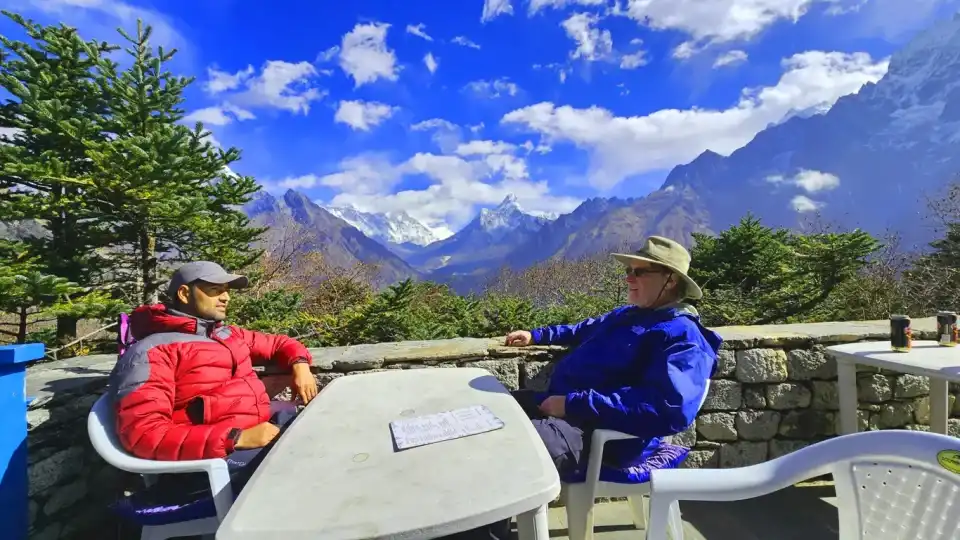
Everest View Hotel Tea Time
This day is significant regarding acclimatization. You do not lie around and sleep, but just go on a little walk up the hill. You ascend Everest View Hotel (3,880 m / 12,730 ft) to have a panoramic view of the mountain.
From this perspective, you can see the Everest, Ama Dablam, and other nearby mountains. Having rested there a bit, you go back to Namche at 3,442 m / 11,293 ft to rest. This technique helps your body to get used to the altitude.
During the afternoon, you may visit the Sherpa Culture Museum or visit the town. To keep your strength, you take lots of fluids, and you eat healthy food.
Day 7: Trek from Namche to Tengboche (3,860 m / 12,664 ft)
Walking Hours: 5 to 6 hours Trekking
Meals Included: Breakfast, Lunch And Dinner
Accommodation: Tea houses
Max. Altitude: 3,860 m / 12,664 ft
Distance: 10 km walking
You leave Namche and take a picturesque path on the mountainside. The trail has great panoramas of Everest and Ama Dablam. Having gone down to the river at Pungki Thanka, you ascend slowly up to Tengboche.
The climb lasts approximately 5-6 hours with a distance of 9-11km. The climb is gradual yet comfortable and slow. In the afternoon, you arrive at Tengboche, 3,860 m / 12,664 ft.
Tengboche is also noted for its monastery, which is the largest in the Khumbu region. You go to the monastery and watch evening prayers. This is a unique place to visit because of the serene environment and mountainous landscape.
Day 8: Trek from Tengboche to Dingboche (4,410 m / 14,469 ft)
Walking Hours: 5 Hours Trekking
Meals Included: Breakfast, Lunch And Dinner
Accommodation: Teahouses
Max. Altitude: 4,410 m / 14,469 ft
Distance: 11 km walking
On this day, you walk in an open and alpine terrain. You have your breakfast, cross the Imja Khola, and then ascend gradually to Dingboche.
This journey lasts approximately 5 hours, and the distance is approximately 10-12km. Forests are thinner, and the ground is more rugged. Fields are covered with stone-walled fields to shield them against cold winds.
You reach Dingboche, 4,410 m / 14,469 ft, by afternoon. Air is less dense, and hence you walk slowly and consume more water. The mountains around form spectacular scenery, such as Lhotse and Ama Dablam.
Day 9: Acclimatization in Dingboche (5,083 m / 16,676 ft)
Walking Hours: 5 to 6 Hours Trekking
Meals Included: Breakfast, Lunch And Dinner
Accommodation: Tea houses
Max. Altitude: 5,083 m / 16,676 ft
Distance: 8 km walking
You are to hike today to Nagarjuna Hill above Dingboche as an acclimatization exercise. The trail ascends gradually to an approximate elevation of 5,083 m / 16,676 ft. You move slowly, and you have short pauses when necessary.
Its increase is approximately 5-6 hours. At the summit, you have panoramic scenery of other mountains and valleys. The exercise assists your body in adapting to an elevated altitude.
Having stayed at the point of view, you come back down to Dingboche. During the afternoon, you have a rest, warm meals, and some preparation for the more rugged parts of the walk ahead.
Day 10: Trek from Dingboche to Lobuche (4,910 m / 16,108 ft)
Walking Hours: 5 to 6 hours Trekking
Meals Included: Breakfast, Lunch And Dinner
Accommodation: Tea Houses
Max. Altitude: 4,910 m / 16,108 ft
Distance: 11 km walking
Today, you proceed further into Khumbu. The trail ascends at a slow pace towards Thukla after breakfast in Dingboche at 4,410 m / 14,469 ft. It gets drier and rockier, plants are scarce, and the mountains have more open spaces.
Following lunch, it gets very steep to Thukla Pass, where there are stone memorials commemorating those climbers who have lost their lives on Everest and other nearby mountains. It is a solemn and hearty spot.
You descend the pass along the bank of the Khumbu Glacier. The trail is cut through some rugged moraine, and you walk slowly and carefully. It takes you an afternoon to reach Lobuche at 4,910 m / 16,108 ft. The little village is situated between the giant mountains and glacier fields.
Day 11: Trek from Lobuche to Gorak Shep, hike to Everest Base Camp and back to Gorak Shep (5,364 m / 17,598 ft)
Walking Hours: 8 to 9 Hours Trekking
Meals Included: Breakfast, Lunch And Dinner
Accommodation: Tea houses
Max. Altitude: 5,364 m / 17,598 ft
Distance: 15 km walking
It is a very critical day of your Everest Base Camp Trek by road. You start in the early morning at Lobuche altitude and head towards Gorak Shep. The path is made up of rocky glacier tracks where one can see the ice formation and high mountains. You take a little break at Gorak Shep, then head towards the Everest Base Camp at 5364 m / 17598 ft.
The land is rugged with gray rocks and glacial streams. Once you have reached base camp, you celebrate this special accomplishment. You get a view of Khumbu Icefall and the mountains that surround it, such as Nuptse and Pumori. It is a self-pride and sentimental experience.
Once you have taken photos, you go back to Gorak Shep and sleep for the night. The air is cold and dry, and you sleep early on.
Day 12: Hike to Kala Patthar (5,545 m / 18,192 ft) and Trek to Pheriche
Walking Hours: 8 Hours Trekking
Meals Included: Breakfast, Lunch And Dinner
Accommodation: Tea houses
Max. Altitude: 5,545 m / 18,192 ft
Distance: 14 km walking
You wake up early in the morning to go on a hike to the highest point of your trek, 5,545 m / 18,192 ft, Kala Patthar. The ascension is slow and gradual in the cold morning air. At the peak, we have a panoramic view of the Everest, Lhotse, Nuptse, and Ama Dablam. There is nothing like the sunrise at Everest.
You roam around in the viewpoint and go back to Gorak Shep to eat breakfast. Then you go on downhill past Lobuche and Thukla to Pheriche. The lower the altitude, the simpler the breathing.
In the afternoon, you reach Pheriche. The valley is wider and greener than the glacier area above.
Day 13: Trek from Pheriche to Namche Bazaar (3,442 m / 11,293 ft)
Walking Hours: 8 Hours Trekking
Meals Included: Breakfast, Lunch And Dinner
Accommodation: Teahouses
Max. Altitude: 3,442 m / 11,293 ft
Distance: 20 km walking
It is quite a long, but rewarding descent to today. You leave Pheriche and walk the trail in the same way back, through villages you are used to. As one descends, the air becomes thicker and easier to breathe.
Tengboche is situated at 3,860 m / 12, 664 ft and can be visited to rest. A return to forest areas, the path has rhododendron trees and Juniper. Having crossed rivers and small bridges, you finally make the last ascent to Namche Bazaar at 3,442 m / 11,293 ft.
The final uphill is tiring, although you go slowly and make brief rests. On the way to Namche, you will be able to experience the bustling environment, cozy dining rooms, and maybe a bakery snack.
Day 14: Trek from Namche to Surke (2,535 m / 8,317 ft)
Walking Hours: 7 to 8 Hours Trekking
Meals Included: Breakfast, Lunch And Dinner
Accommodation: Tea houses
Max. Altitude: 2,535 m / 8,317 ft
Distance: 18 km walking
You walk out of Namche at 3,442 m / 11,293 ft after breakfast and down to the bottom of the Khumbu valley. You retrace footsteps through Monjo and Phakding. The path is primarily downslope, and hence you walk very slowly to avoid injuring your knees.
You go through suspension bridges and go by little villages on the Dudh Koshi River. It becomes warmer as you get down. At approximately 2,535 m / 8,317 ft, by the end of the afternoon, you get to Surke. The village is less bustling and noisier than Namche.
In the evening, you have a leisurely dinner and get ready for the last day of trekking.
Day 15: Trek from Surke to Jubing (2,005 m / 6,578 ft)
Walking Hours: 6 hours Trekking
Meals Included: Breakfast, Lunch And Dinner
Accommodation: Tea houses
Max. Altitude: 2,535 m / 8,317 ft
Distance: 14 km walking
Today, you will finish your Everest Base Camp Trek by road. You leave Surke at 2,535m/8,317 ft and go through village paths and forest trails to head back toward Jubing. The road has small hills and descents over peaceful hills.
You are over little bridges and through farmland and country houses. The opinions are different now, as you are walking back. Your guide can discuss your developments and the way you fit in at high altitude.
You reach Jubing in the afternoon. You are celebrating your Everest Base Camp trek completion with your team. You spend your last evening in a teahouse having dinner.
Day 16: Drive from Jubing to Kathmandu
Walking Hours: 11 to 12 hours driving
Meals Included: Breakfast And Lunch
Accommodation: 3 star Standard Hotel
Max. Altitude: 1,350 m / 4,429 ft
Distance: 300 km driving
When you complete the trek, you head off in a 4WD to make the long trip back to Kathmandu at 1,350 m / 4,429 ft. The trip lasts approximately 11-12 hours, depending on the condition of the roads.
The journey is on hills, rivers, and small towns. You can have lunch midway. It is a long drive, but it allows time to consider what you have done in visiting the Everest Base Campand Kala Patthar.
In the evening, you reach Kathmandu and take accommodation in your hotel. A hot shower and clean clothes are so good after several days on the trail.
Day 17: Final Departure (1,350 m / 4,429 ft)
Walking Hours: 30 Minutes Driving
Meals Included: Breakfast
Max. Altitude: 1,350 m / 4,429 ft
Distance: 6–8 km driving
The Everest Base Camp Trek by road is complete today in Kathmandu, 1,350 m / 4,429 ft. Our team will make your transfer to the airport after breakfast at your hotel. It normally takes around 30 minutes to drive, depending on the traffic.
You reach the airport approximately three hours before your international flight. And, as you stand to leave, you think of the experience you have gone through, the silent paths of Solu up to the Everest Base Camp of 5,364 m / 17,598 ft.
In case you want to spend more time in Nepal, you may visit more cultural places or take another small excursion. When you go home, you take with you the memories of the trek and the pride that you reach to the Everest Base Camp Trek by road.
Everest Base Camp Trek by Road Cost
Quotation Can be Different According to Number of Days in Trekking, Your Country of Residence, Number of days in City, Guide quality, Equipments, Flights Company, Hotels quality in City, Transportation Type, Number of Trekkers in your Groups, Teahouses quality of Trekking, Meals what include in Trekking, Other Numerous included Items. For exaxt Cost Please Message us in whatsapp. +977-9841965533
-
The package includes private ground transportation, covering airport transfers.
-
Accommodation for two nights with breakfast is provided at a 3-star hotel in Kathmandu.
-
Throughout the trek, you will enjoy full board meals with tea/coffee (Breakfast, Lunch, and Dinner).
-
Accommodations in the best available lodges during the trek are ensured, with attached bathrooms featuring hot showers in Lukla, Phakding, and Namche.
-
A highly experienced, friendly guide and porters (1 Porter for 2 hikers) are part of the package, covering their food, accommodation, salary, equipment, and insurance.
-
Essentials such as a duffle bag for trekking, a down jacket, and a sleeping bag are included.
-
All necessary trek permits are taken care of.
-
Participants receive Mission Himalaya Treks and Expeditions T-shirt, a trekking map, and a trip achievement certificate.
-
Government taxes and office service charges are also encompassed within the package.
-
Nepal forward process upon your arrival at Kathmandu’s Tribhuvan International Airport. You can easily obtain a multiple-entry tourist visa valid for 30 days by paying a fee of US$ 50 or an equivalent amount in foreign currency. If you require a longer stay, multiple-entry tourist visas for 90 days can be obtained by paying a fee of US$ 100. It is recommended to carry two copies of passport-size photos for the visa application pEntry Visa: Obtaining a visa for Nepal is a straightrocess.
-
Excluded are meals that are not specifically mentioned in the ‘Meal Inclusions’ outlined in the itinerary.
-
Travel insurance is not covered in the package.
-
International airfare is not included.
-
Cold drinks, including but not limited to coke, water, Fanta, etc., are not part of the provided amenities.
-
Personal expenses such as snacks and other miscellaneous items are not incorporated.
-
Hot showers during the trek are not inclusive, except for designated locations like Phakding, Namche, and Lukla.
-
WIFI internet access during the trek is not provided.
-
Personal trekking equipment is not supplied and remains the responsibility of the participant.
-
Tips and gratuities for trekking staff and drivers are not covered within the package.
Trip Gear


Everest Base Camp Trek by Road Related Information
Trek Difficulty for Everest Base Camp Trek by Road
The Everest Base Camp Trek by Road is considered to be a moderate trek, although it is not to be underestimated as a high-altitude adventure. This moderate trek takes longer than 1 week and involves a 5-6-hour walk per day. During this adventure, you will walk for days in a row and walk over 130 kilometers.
The Everest Base Camp trek by road is made complicated by the altitude. You arrive at Everest Base Camp 5,364 m / 17,598 ft and hike Kala Patthar at 5,545 m / 18,192 ft. Oxygen is less at such heights, thus your speed is slow. The path features stone steps, rocky terrain, glacier moraine, and prolonged inclines.
The Everest Base Camp Trek by Road is a unique walk due to the gradual pace. The starting point is the lower Solu and then gradually proceeds up the Khumbu region. It is a gradual build up that can accommodate trekkers.
Through proper acclimatization, patience, and preparation, the majority of the healthy trekkers can complete this journey.
Weather and Best Season
The weather is significant to the Everest Base Camp Trek by Road since the trail and road conditions are important. It is advisable to conduct this trek in the dry seasons to ensure that it is safe to drive and the mountain can be seen clearly.
The spring (March to May) is mild, and there are rhododendron forests in blossom. The season of autumn (September to November) offers stable weather conditions, dry trails, and good visibility. These are the seasons that are most comfortable and scenic. In these months, the Everest is clearly visible in some of its views, such as the Kala Patthar at 5,545 m / 18,192 ft.
Heavy rain is experienced during the monsoon season (June to mid-September). The dirt roads to Jubing can become muddy and difficult, especially after heavy rain. In winter (December to February),the temperatures above 4,000 m / 13,123 ft are very below freezing point, and snow can be experienced at higher elevations.
Temperatures at altitude change rapidly regardless of the season. It is cold in the mornings and evenings, and warm in the sun at noon. Multi-layered dresses are significant. Mission Himalaya Treks assists in organizing departures during the most appropriate season in order to have a good and safe trek.
Food and Drink
Food is basic, warm, and nutritious during the Everest Base Camp Trek by Road. Mission Himalaya Treks in Kathmandu covers breakfast at the hotel. There is a variety of local restaurants where you can select your lunch and dinner on your own.
The trekking days include three meals per day that include breakfast, lunch, and dinner. Teahouse menus have Nepali, Tibetan, Indian, and simple Western foods. Known dishes such as dal bhat (rice, lentil soup, and vegetables) are a favorite meal due to a constant supply of energy. You will also have noodles, fried rice, potatoes, soups, eggs, and porridge.
Being on top of 4,000 m / 13,123 ft and above, you might lose your appetite. You should take frequent meals, though you might not feel hungry. Even more essential is hydration. Consume plenty of water that is either boiled, purified, or bottled.
Also, the guides at Mission Himalaya Treks assist in the choice of lodges with good kitchen hygiene. Maintaining a healthy diet helps you to be strong until the Everest Base Camp at 5,364 m / 17,598 ft.
Altitude Sickness and Suggestions
The health risk predominant in the Everest Base Camp Trek by Road is altitude sickness. The higher you go, the less oxygen there is. The symptoms can be a headache, nausea, dizziness, and bizarre fatigue. These may begin over 3,000 m / 9,843 ft and may grow higher still, such as at Dingboche at 4,410 m / 14,469 ft.
The prevention starts with slow pacing. Move slowly and do not hurry up the hill. Mission Himalaya Treks also has acclimatization days in Namche and Dingboche so that you can allow your body to the natural way to adjust naturally. Adaptation is also facilitated by drinking enough water and proper eating.
One of the major guidelines is that do not keep going up in the case of worsening symptoms. In case of extreme headache, disorientation, or dyspnoea, you should report it to your guide as soon as possible. The best treatment is descent.
Listening to your body and listening to your guide provides a safe and enjoyable experience. Early intervention will stop severe troubles and secure your well-being.
Preparation and Fitness Guide
The planning of the Everest Base Camp Trek by Road needs to start several weeks before reaching Nepal. It is important to develop stamina first. You must feel free to walk 5-7 hours a day on rough surfaces.
Do the exercise like running, climbing mountains, or climbing stairs. Introduce strength training twice a week with squats, lunges, and step-ups. Such exercises are useful on long downhill routes. Training with a light backpack can also make shoulders and hips comfortable.
At elevation, breathing control is significant. Slow and steady breathing helps you keep your energy strong during hikes. Speed is not important, but consistency is the key.
Proper equipment, such as trekking shoes, warm clothes, gloves, sun protection, and a headlamp, is also suggested. Prior training and relaxation of the mind make the Everest Base Camp Trek by Road more pleasant and fulfilling.
Visa and Permits
A majority of the travelers in Nepal require a tourist visa. It is available upon arrival at Tribhuvan International Airport or in advance, at a Nepali embassy.
Khumbu region special permits are required for the Everest Base Camp Trek by Road. They are the Sagarmatha National Park entry permit and the Khumbu Pasang Lhamu Rural Municipality entry permit. With these documents, access to mountain zones with restricted access is made available.
All the necessary permits are handled by the Mission Himalaya Treks. This assistance eliminates misunderstanding and wastage of time at checkpoints.
It is important to always carry valid permits since the officials inspect documents on the trail. When you have the right permits, you will be able to have a total of enjoying your adventure in the Everest Base Camp Trek by Road.
Health & Safety
The Everest Base Camp Trek by Road would require health and safety precautions. It is a mountainous trek, which peaks at 5,545 m / 18,192 ft at Kala Patthar. There is a rapid variation in weather, and in remote locations, medical facilities are minimal.
The itinerary prepared by Mission Himalaya Treks includes safe overnight locations. Medical assistance in the region is also provided by the Himalayan Rescue Association Clinic in Pheriche at an altitude of 4,210 m, 13,812 ft.
Your guide controls your health conditions day by day and looks after any signs of altitude. Early reporting of discomfort is required. It is easier to cope with minor problems than major ones.
Guard against the usual problems of sunburns, dehydration, blisters, and stomach upsets. Wear sunscreen and lip balm, and wear layers of clothing. Bring first aid supplies and personal medicine.
Teamwork is essential in safe trekking. Effective communication, gradual rhythm, and accountability in decision-making can be useful in making the Everest Base Camp Trek by Road a successful experience.
Transportation
Road transportation is a key feature of the Everest Base Camp Trek by Road. You do not need to book a flight to Lukla, but use a 4WD Jeep from Kathmandu to Jubing. It is an 11-12-hour journey through hills, rivers, and villages.
The initial part leading to Salleri is partially tarmac. The last distance to Jubing is a rough dirt road, which makes it a very careful road to drive. Mission Himalaya Treks undertakes the private transportation of the ground to coordinate effectively.
When you complete the trek and you come back to Jubing, then you drive back to Kathmandu. This is a road trip that enables you to explore more of rural Nepal than the short flight option does.
The Everest Base Camp Trek by Road is the best option for travelers who do not want to take it by air or those who want to have a slower entry into the mountain. The road can be considered as a part of the adventure, as it provides cultural information and aesthetic sightseeing of the mountain experience.
Travel Insurance
Travel insurance is very important for travelers doing the Everest Base Camp Trek by Road. The trek goes to a high altitude with a height of 5,545 m / 18,192 ft at Kala Patthar. Trekking at this altitude is not covered by all insurance policies, so you have to check properly.
Your policy must cover an emergency helicopter evacuation, medical treatment, and trip interruption coverage. Mountainous areas are remote, and there are poor medical facilities; evacuation may be costly without insurance.
The travel insurance is not a part of the package of Mission Himalaya Treks, and therefore, you need to settle it in advance. Carry copies of your policy when trekking.
Prevention is paramount even in the presence of insurance. Pace yourself, drink plenty of water, and adhere to acclimatization. The Everest Base Camp Trek by Road is safe if handled responsibly; however, good insurance is a sure way to relax and ensure finances in the unfortunate occurrences.
Alternative Routes
There are various ways of getting to the base of Mount Everest, with the Everest Base Camp Trek by Road being one of the most peaceful means of access. Mission Himalaya Treks provides a number of options based on your style of traveling and schedule.
Some trekkers enjoy the traditional trail of Everest Base Camp by air to Lukla. This one is time-saving, but it very much relies on the weather in the mountains. The other option begins at Salleri and involves a flight back to Lukla. This will offer a combination of air and road transportation.
Side trips can also be added once you arrive at Namche Bazaar (3,442 m / 11,293 ft). People visit the Gokyo Lakes area, or undertake additional acclimatization, prior to going to the Everest Base Camp at 5,364 m / 17,598 ft. These extensions take more days and fitness.
The Everest Base Camp Trek by Road can be customized by Mission Himalaya Treks depending on your time, fitness, and interest in either cultural or scenic diversity. The most optimal course is one that would balance between safety, height management, and personal ambitions.
Your Extra Expenses
The Everest Base Camp Trek by Road has all basic services included in the package, yet on the teahouse treks, some additional charges are widespread.
You have to pay for cold drinks, bottled water, snacks, and personal expenses on your own. Most of the villages have hot shower facilities (generally charged), but Wi-Fi and internet access are not free and get more expensive as you get nearer to the Everest Base Camp at 5,364 m / 17,598 ft.
Electronic appliances are usually expensive to charge. Higher villages use solar or limited hydro power, so charging fees are normal. Carrying a power bank allows minimizing these charges.
Tips for guides and porters are another extra cost. These minor yet frequent costs will leave you without any unpleasant surprises and allow you to enjoy your experience without any inconveniences.
Language & Communication
When you are on the Everest Base Camp Trek by Road, you will listen to Nepali and Sherpa languages in the villages. Nonetheless, it is not difficult to communicate since guides of the Mission Himalaya Treks are English-speaking.
In Kathmandu and bigger villages such as Namche Bazaar at 3,442 m / 11,293 ft, the lodge owners and shopkeepers speak very simple English. It is not much of a problem to order food or ask a few basic questions. The guide also assists you in the explanation of local customs and traditions.
Language is not the only thing about communication. It also implies respect. Only take close-up photos of people after asking for their permission. Circle round mani stones and chortens clockwise. Speak low within monasteries.
In case of allergies to food or medical conditions, it is better to inform your guide about that so that the small problems do not become serious problems. The Everest Base Camp Trek by road becomes more valuable when it is supported by respect and understanding.
Mobile Network, Internet & Charging Facilities
Internet connection in the Everest Base Camp Trek by Road is limited and occasionally unreliable. Wi-Fi is not included in the trekking package, and hence you should consider paying for it in the tea houses.
Signal strength is usually weaker in the lower villages. Mobile coverage and paid Wi-Fi can often be found in such places as Namche Bazaar, with 3.442 m / 11.293 ft. The higher you go, the weaker and slower the connectivity is.
Most teahouses have charging facilities, which are usually an additional fee. In the higher villages, electricity might be based on solar power, and this will restrict charging time. It is better to have a power bank and have your phone in airplane mode, which will save battery.
You should see internet access as a bonus, not a guarantee. The limited connectivity when starting the Everest Base Camp Trek by Road should be informed to the family to keep the expectations real.
Don’ts on This Trip
During the Everest Base Camp Trek by Road, there are several things that you should not overlook. First, do not rush your pace. Excessive speed exceeding 3,000 m / 9,843 ft exposes the person to the danger of being struck by altitude sickness.
Symptoms like headache or dizziness are not to be ignored, especially above Dingboche at 4,410 m / 14,469 ft. You must tell your guide early. It is unsafe to attempt to conquer the Everest Base Camp of 5,364 m / 17,598 ft when one is feeling unwell.
Never carry any unnecessary weight. Additional goods weigh heavier every increase in altitude. Carry minimal clothes and equipment.
Do not depend entirely on Wi-Fi and charging facilities. Power and signal are limited.
Lastly, do not disrespect local culture. In monasteries and villages, always be polite. Good etiquette in the Everest Base Camp Trek by Road would make the experience more fulfilling and secure.
Trip Extension
Most of the travelers spend more time in Nepal after they have completed the Everest Base Camp Trek by Road. Mission Himalaya Treks can enable you to organize other experiences in accordance with your interests.
You can visit heritage sites, temples, and local markets in Kathmandu. Cultural tours do not take too much strain after getting back from the high-altitude places such as Kala Patthar 5,545 m / 18,192 ft.
If you are fond of nature, there are lowland national parks where you could spend time having a wildlife safari. The hot weather is in contrast with the cold air in the mountains.
Other trekkers also continue their travel in the Everest region by including routes like Gokyo Lakes or other closely located passes. The alternatives need additional days to undergo safe acclimatization.
The Everest Base Camp Trek by Road is already an in-depth experience, and yet some reflections can enhance your trip to Nepal.
Photography & Drone Rules
There is an unlimited photography opportunity in the Everest Base Camp Trek by Road. Between Namche Bazaar 3,442 m / 11,293 ft and Everest Base Camp 5,364 m / 17,598 ft, there is a change in landscapes by the day. Photography on hand is mostly permitted in the open, but it is always better to seek permission before taking pictures close to people.
Certain rules may be set in monasteries regarding indoor photography. Obey local directions and show reverence for sacred places.
In Nepal, drones are closely controlled, particularly within the Sagarmatha National Park. Before flying a drone, you have to get clearance from the Civil Aviation Authority of Nepal and the concerned government offices. Drone usage may attract fines or seizure without authorization.
The weather and the wind conditions in higher altitudes like Kala Patthar at 5,545 m / 18,192 ft can also be dangerous for the flying of drones.
Mission Himalaya Treks will be able to provide advice, but it is up to you to take care of the legal issues. Another thing that makes the Everest Base Camp Trek by Road enjoyable to all is the respectful photography.
Tips for First-Time Visitors
When it is your first Everest Base Camp Trek by Road, you need to work on consistent practices. Begin slowly and have a steady approach.
Be serious with acclimatization days. Short hikes above Namche and Dingboche at 4,410 m / 14,469 ft help your body adjust before you climb to Everest Base Camp at 5,364 m / 17,598 ft.
Wear clothes in layers because temperatures vary rapidly. Wear sunscreen and sunglasses daily to combat intense sunlight in a mountain.
Bring along personal money to spend in local shops, charge bills, and take hot showers. Higher villages are not equipped with ATMs.
Above all, be there. Everest Base Camp Trek by Road is not focused on reaching a destination. It is a journey of a smooth passage from the green hills to the glacier scenery. Be respectful to the mountains, follow your guide from Mission Himalaya Treks, and have every moment of the adventure.
Everest Base Camp Trek by Road FAQ'S
A
The last dirt part of the drive may be rough and dusty, particularly when it has rained, yet 4WDs cope with it effortlessly.
A
Some travelers experience mild cases of motion sickness when going through curvy roads; medication can be advised if you are sensitive.
A
Outside Kathmandu, ATMs are extremely scarce, and therefore, take enough cash out from Kathmandu itself.
A
Access to other exit routes can be organized in certain instances based on weather, location, and cost.
A
There are good bakery cafes in Namche, but not in the lower villages of Solu,
A
Yes, although you will need a warm sleeping bag in colder villages, which is strongly advised.
A
Yes, vegetarian foods are well found all along the trek.
A
The trekking days usually start at 7:00-8:00 AM, according to the distance and weather conditions.
A
In a few villages, there are basic health posts, but no more advanced treatment until Pheriche.
A
Yes, under preparation, even pacing, and acclimatization, beginners are likely to complete it.
A
No, water must be treated, boiled, or filtered before it can be drunk.
A
It does not have a rigid age restriction, and participants are supposed to be well-fit physically.
A
Yes, Kathmandu is easily accessible in terms of renting or buying most of the trekking gear.
A
The lower Solu section is quieter, and the trail becomes busier after you join it at Phakding.
A
Porter service is, in most cases, provided, although there are restrictions on the weight of luggage due to safety reasons.
Tripadvisor Reviews
Google Reviews
5.0
317 reviews